




Quick Facts
Introduction
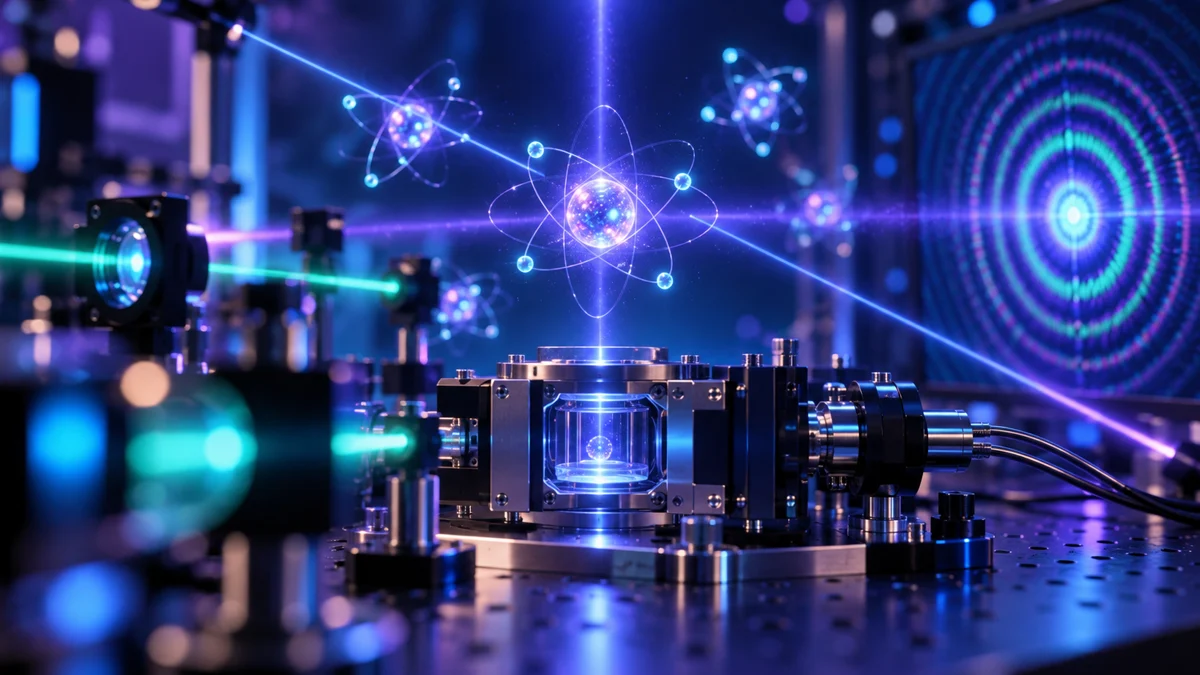
Understand quantum sensors in simple language, including atomic clocks, magnetometers, single-photon detectors and atom interferometers.
A thermometer, camera or phone location chip is a sensor: it converts a physical change into information. A quantum sensor goes further by using a measurable quantum property, such as an atomic energy level, electron spin, superconductivity or the wave behaviour of atoms. This does not make every quantum device automatically better, but it can provide a new level of precision for problems where ordinary instruments reach their limits.
For related updates, explore , Tech News, Top Universities and Artificial Intelligence for more information.
How does a quantum sensor work?
Atoms and light occupy specific energy states rather than every possible value. Scientists can prepare a quantum system, expose it to the quantity they want to measure and observe how its state changes. Because the relevant energy differences or frequencies can be extremely stable, a small change in the outside world can be detected as a measurable shift in light, phase, frequency or magnetic response.
Four important examples
1. Atomic clocks
Atomic clocks use the predictable transition between atomic energy levels to keep time. Their accuracy supports telecommunications, navigation and scientific measurement. Satellite navigation systems depend on accurate timing because a small timing error can become a large position error.
2. Quantum magnetometers
Magnetometers measure magnetic fields. Devices based on atomic spins or superconducting circuits can detect very weak fields for geology, biomedical research, materials testing and navigation experiments.
3. Single-photon detectors
A single-photon detector is designed to register extremely small amounts of light. Such detectors are useful in astronomy, optical communications, quantum research and experiments where counting individual photons matters.
4. Atom interferometers and gravimeters
Atoms can behave like waves. In an atom interferometer, laser pulses split and recombine matter waves; the resulting interference pattern can reveal tiny changes in acceleration or gravity. Potential uses include underground mapping, resource exploration and navigation in places where satellite signals are unavailable.
Why quantum sensors matter
The promise is not limited to laboratory demonstrations. More accurate sensors could help monitor infrastructure, find underground resources, improve medical imaging, measure climate-related changes and strengthen time synchronisation. The practical challenge is that many systems need lasers, shielding, low temperatures, careful calibration or specialised operators. Miniaturisation and lower cost will determine how quickly they reach everyday products.
The NIST quantum sensing guide explains that quantum sensors can exploit atomic energy levels, spin, superconductivity and photon behaviour. The article is educational, not investment or medical advice. Explore more explainers in our Knowledge Base.
FAQs
Are quantum sensors the same as quantum computers?
No. Quantum computers process information using quantum states, while quantum sensors use quantum behaviour to measure physical quantities. A project may use both, but the purposes are different.
Do quantum sensors replace normal sensors?
Usually not. Classical sensors remain cheaper and practical for many jobs. Quantum sensors are valuable when sensitivity, stability or accuracy justifies their extra complexity.
Can quantum sensing improve GPS?
Research-grade atom interferometers may eventually provide navigation support in GPS-denied environments, but availability, size, cost and drift remain important engineering challenges.






Comments (0)
No Comments Found