





Quick Facts
Introduction
The October 2026 Hunter’s Moon reaches full illumination on October 26. Find the best viewing window, photography tips and the meaning behind its name.
The October 2026 full moon, traditionally called the Hunter’s Moon, reaches peak illumination on Monday, October 26. Skywatchers in North America, the UK, Australia and other regions can enjoy a bright lunar display, with the most dramatic view usually coming around local moonrise.
For related updates, explore , Tech News, Top Universities and Artificial Intelligence for more information.
Quick Viewing Facts
- Peak illumination: October 26, 2026, at about 12:12 a.m. Eastern Daylight Time.
- The moon may look especially large near the horizon because of the Moon Illusion.
- For many locations, the best practical viewing opportunity is the evening around moonrise.
- A clear eastern horizon and a safe dark location are more important than expensive equipment.
Why It Is Called the Hunter’s Moon
The Hunter’s Moon is the traditional name for the full moon after the Harvest Moon. The name is linked to the seasonal cycle after fields were harvested, when hunters could see animals more easily and prepare food for winter. Moon names are cultural traditions, not scientific classifications, and different communities have used different names over time.
When Should You Watch?
The exact moment of full illumination is less important for casual viewing than the local rise and set times. The moon appears full to the eye for more than one night around the peak. Check a reliable moon-phase service for your city because time zones, latitude and the local horizon change the experience.
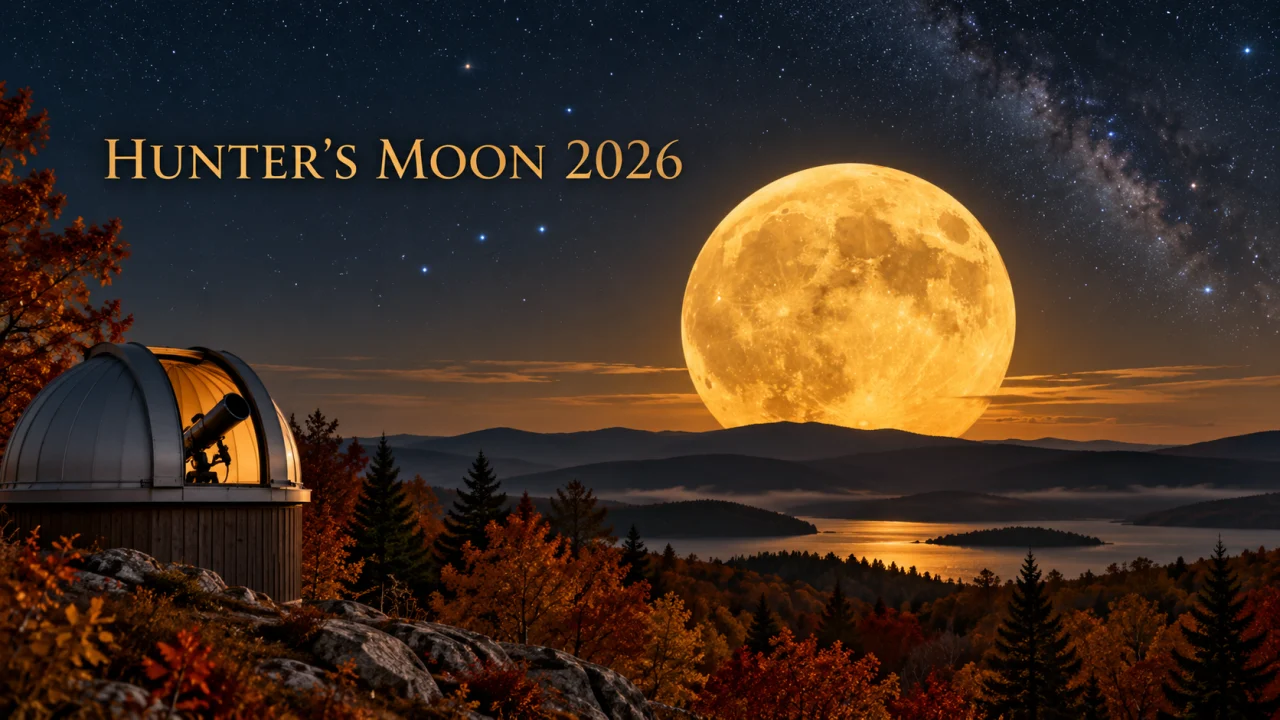
Moonrise close to sunset can create warm orange or yellow tones as moonlight passes through more of Earth’s atmosphere. Buildings, hills and trees near the horizon can add scale to photographs.
How to Photograph the Hunter’s Moon
- Choose a location with a clear view toward the east.
- Use a tripod or stable surface.
- Focus manually on the moon and keep ISO as low as practical.
- Take several exposures because the bright lunar surface can fool automatic metering.
- Include a foreground object for scale, but never photograph from an unsafe road or restricted area.
Can You See It Without a Telescope?
Yes. The full moon is easy to see without equipment if clouds and local light pollution do not block the view. Binoculars can reveal craters and darker lunar plains, while a small telescope offers more detail. Never look at the sun through optical equipment, but ordinary moon viewing is safe for the eyes.
Frequently Asked Questions
Is the Hunter’s Moon a supermoon?
The popular name Hunter’s Moon describes the October full moon. Whether a full moon is a supermoon depends on its distance from Earth, so the terms are not interchangeable.
Will the moon be orange?
It may appear orange or yellow near the horizon because of atmospheric scattering. Higher in the sky it usually looks much whiter.
What if clouds cover the moon on October 26?
The moon will still appear nearly full on the surrounding nights. Check the local forecast and try the evening before or after the peak.
Conclusion
The Hunter’s Moon is a simple, accessible skywatching event with a strong seasonal story. Find a safe place with an open horizon, check local moonrise times and give your eyes a few minutes to adjust. The best view is often the moment the bright disk first appears above the landscape.






Comments (0)
No Comments Found