





Introduction
Explore practical and responsible uses of generative AI in education, including study support, privacy, fact-checking and human oversight.
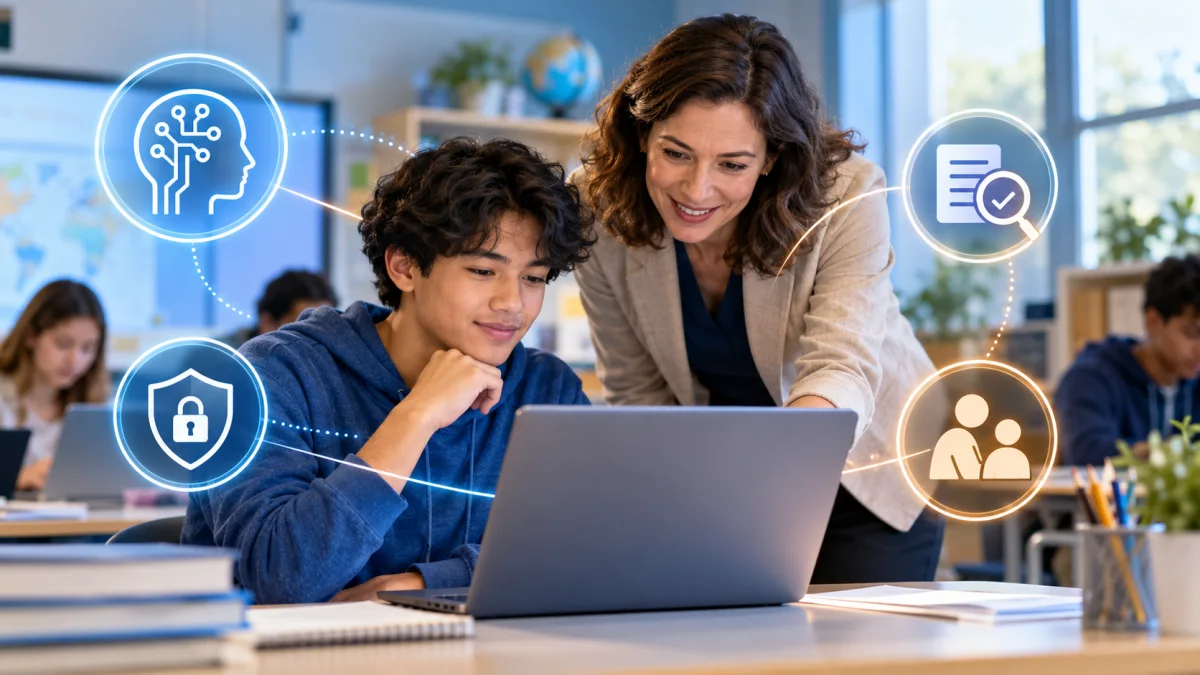
Generative artificial intelligence can produce text, images, explanations, examples, quizzes, and summaries from a user prompt. In education, these tools can support brainstorming, language practice, revision, accessibility, and personalised explanations. They are most useful when treated as learning assistants rather than unquestionable authorities or replacements for teachers.
For related updates, you can also check our latest jobs, scholarships, government schemes, and admissions pages for more opportunities.
Useful learning applications
A student can ask an AI tool to explain a difficult concept at different levels, create practice questions, compare two ideas, suggest a study plan, or provide feedback on the clarity of a draft. A teacher may use it to prepare examples, adapt reading material, or generate discussion prompts. The learner still needs to solve problems, check reasoning, and understand the final work.
AI can make mistakes, invent sources, miss context, reproduce bias, or give an answer that sounds confident but is wrong. For that reason, students should verify important facts with textbooks, official websites, academic sources, or a teacher. Asking the tool to show assumptions and then checking those assumptions is safer than copying a complete response.
Privacy and academic integrity
Do not enter private student records, passwords, medical information, confidential school documents, or another person's personal data into an AI service without clear permission and appropriate safeguards. Users should understand how a platform stores and handles prompts. Schools and families should set age-appropriate rules and explain when disclosure of AI assistance is required.
Submitting AI-generated work as entirely one's own can undermine learning and may violate school or university policies. A responsible workflow is to use AI for ideas, practice, language support, or feedback, then write, solve, cite, and revise independently. Teachers should define acceptable uses clearly so that technology supports fairness rather than creating confusion.
A human-centred approach
Good education includes relationships, judgement, creativity, collaboration, and the ability to learn from mistakes. AI can provide fast interaction, but it cannot fully understand a learner's goals, emotions, culture, or classroom responsibilities. Human teachers and mentors remain essential for context, assessment, safeguarding, and meaningful feedback.
The best question is not whether AI should replace learning, but how it can help people learn more deeply and equitably. Start with low-risk tasks, verify outputs, protect privacy, respect school rules, and keep the learner responsible for the final thinking and work.
Note: This article is for general educational purposes. Follow official local guidance and qualified professional advice where safety or health is involved.
Sources: UNESCO: Guidance for generative AI in education and research
To stay updated with similar content, also visit our schemes, scholarships, jobs, and admissions pages for new opportunities and official updates.
FAQs
What is this article about?
This article explains the main details, timeline, and important updates related to Generative AI in Education: Safe, Ethical and Useful Ways to Learn in a simple, reader-friendly format.
Where can I find more opportunities like this?
You can explore our dedicated jobs, scholarships, schemes, and admissions sections for similar updates, official notices, and recent opportunities.
How often is this page updated?
We refresh important articles whenever new announcements, corrections, or deadline changes become available so readers can stay informed.







Comments (0)
No Comments Found