





Introduction
A practical AI outlook for 2027 covering jobs, education, business automation, personal assistants, small models and the skills humans will need.
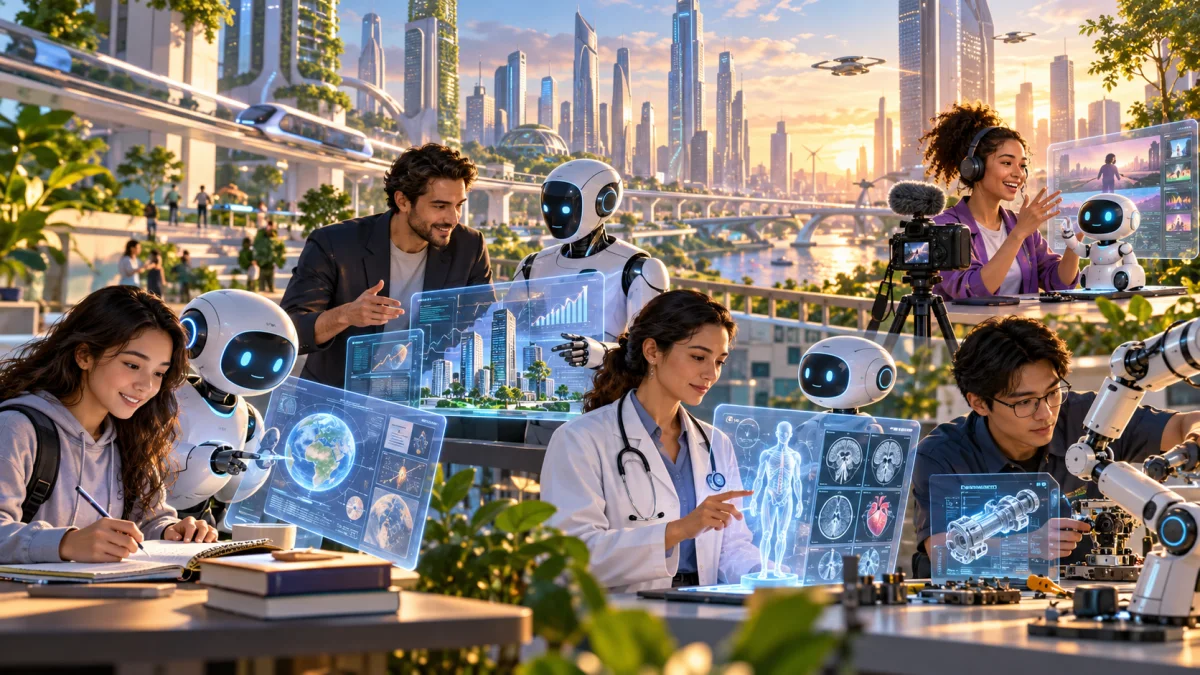
The future of artificial intelligence should be discussed as a set of informed scenarios, not as a guaranteed timetable. Model capabilities, regulation, hardware costs, public trust and business adoption can all change the path. Even so, current developments point toward a 2027 in which AI is more deeply embedded in software, education, customer service, research, design and everyday productivity.
For related updates, you can also check our latest jobs, scholarships, government schemes, and admissions pages for more opportunities.
Likely direction 1: more delegated work
People will increasingly ask AI systems to handle a sequence of tasks rather than one question: gather information, compare options, prepare a draft, update a record and request approval. The most valuable systems will connect to trusted tools and make their actions visible. Fully unattended operation will remain inappropriate for many high-impact tasks, but supervised delegation can reduce routine workload.
Likely direction 2: smaller and more specialised models
Not every task needs the largest available model. Organisations may use a combination of models: a small fast model for classification, a specialised model for a domain task and a stronger reasoning model for exceptions. More work may also happen on devices or private servers when latency and data control matter. This can lower cost, but local systems still need updates, security and quality evaluation.
Likely direction 3: AI-native software
Applications will be designed around natural-language instructions, structured context and continuous feedback. A project-management system may turn a conversation into tasks; an education platform may adapt practice questions; a newsroom may help organise sources; a developer tool may explain a codebase before suggesting a patch. The best products will combine AI flexibility with deterministic rules for important actions.
Jobs and skills
AI is likely to change many jobs through task redesign rather than a single overnight replacement event. Routine drafting, searching, transcription and data transformation may become faster. Human value will remain strong in judgement, relationship-building, domain expertise, accountability, negotiation, creativity and the ability to work with uncertainty. Workers who learn to review AI outputs and improve processes will be better positioned than those who only learn one prompt formula.
Education in an AI-rich world
Schools and universities will need to teach students how to use AI without outsourcing understanding. Assessment may place more emphasis on oral explanation, project work, source evaluation, practical demonstrations and version history. Students should learn how to ask precise questions, check evidence, protect privacy and acknowledge AI assistance. Teachers remain essential for context, motivation, care and judgement.
How to prepare for 2027
- Build basic AI literacy across the organisation, not only in the technology team.
- Choose one or two low-risk workflows and measure the results.
- Create a review policy for factual, private and public-facing outputs.
- Keep human skills strong: writing, maths, communication, research and decision-making.
- Expect tools to change; learn principles that transfer across vendors.
Source: OpenAI: How agents are transforming work
Source: Anthropic: 2026 State of AI Agents Report
Source: Apple: New intelligence frameworks and tools
Important: AI tools, features, prices and availability change quickly. Verify current product documentation, privacy terms, copyright rules and safety controls before using an AI system for important work.
To stay updated with similar content, also visit our schemes, scholarships, jobs, and admissions pages for new opportunities and official updates.
FAQs
What is this article about?
This article explains the main details, timeline, and important updates related to The Future of AI: What May Change by 2027 in Jobs, Education and Business in a simple, reader-friendly format.
Where can I find more opportunities like this?
You can explore our dedicated jobs, scholarships, schemes, and admissions sections for similar updates, official notices, and recent opportunities.
How often is this page updated?
We refresh important articles whenever new announcements, corrections, or deadline changes become available so readers can stay informed.







Comments (0)
No Comments Found