





Quick Facts
Introduction
WWF-Pakistan has recorded a 45-foot sperm whale off Karachi, the first sighting on the Sindh coast. Learn where it was seen and why it matters for marine life.
Most people do not think of Karachi as whale country, which is why this story has spread so fast. A sperm whale off the Sindh coast, the kind of animal most Pakistanis only know from documentaries or Moby-Dick, was filmed only a few hours' sail from the country's largest city. For marine scientists, it is a useful reminder of how little is known about what lives in Pakistan's deep offshore waters.
For related updates, explore Jobs, Scholarships, Government Schemes and Admissions for more information.
Where and How the Whale Was Seen
According to WWF-Pakistan, the whale was spotted during a maritime expedition by Zahid Maker, a board member of the organisation, around 40 nautical miles southwest of Karachi. Footage of the encounter showed the features that identify the species: the distinctive blowhole, skin markings and a prominent hump.
Earlier sightings of live sperm whales in the country came from the Balochistan coast. WWF-Pakistan reported the first live sighting in Pakistani waters in September 2017, when fishermen spotted a pair off Gunz near Jiwani. Before that, only remains had been recorded, including a skeleton found at Sonara Beach near Karachi in December 2005.
| Species | Sperm whale (Physeter macrocephalus) |
|---|---|
| Estimated length | About 45 feet |
| Location | Around 40 nautical miles southwest of Karachi |
| Reported by | WWF-Pakistan |
| Conservation status | Classed as vulnerable |
Sperm Whales: What Makes Them Remarkable
Sperm whales are among the deepest-diving mammals on the planet. They typically dive to between 300 and 800 metres to feed and can reach depths of one to two kilometres. They mainly eat cephalopods, such as squid and octopus.
That diet offers a clue about why one might be found here. Pakistan's coastal and offshore waters hold several squid species, including the purpleback flying squid and diamondback squid, both of which form part of the whale's diet. In other words, this animal may have had a very good reason to be in the area.
How to Recognise a Sperm Whale
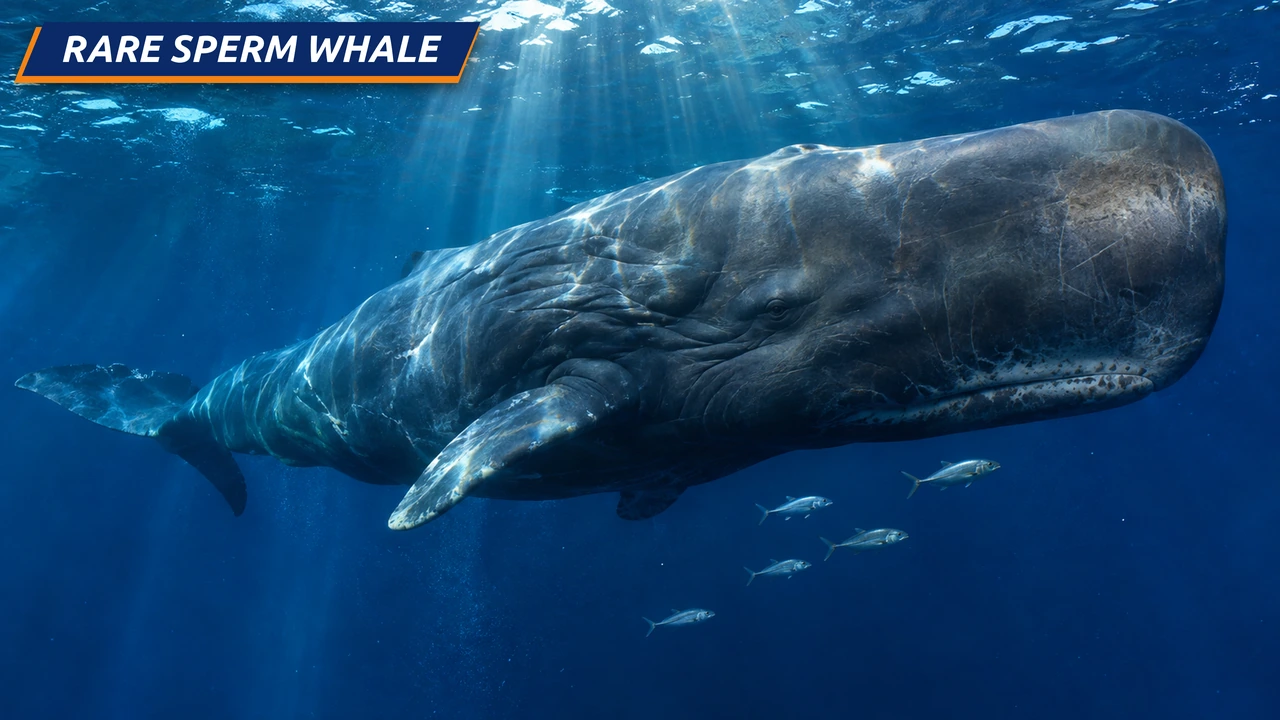
Few whales are easier to identify once you know what to look for. A sperm whale has an enormous, box-shaped head that makes up roughly a third of its body, and narrow lower jaw lined with teeth. It is the largest toothed predator in the world, and it has the largest brain of any animal.
At the surface, the blow is a useful clue. A sperm whale's single blowhole sits towards the left front of its head, so its spout angles forward and to the left rather than rising straight up. Instead of a tall dorsal fin, it has a low hump on its back, followed by a series of knobbly ridges, which is exactly the prominent hump visible in the WWF-Pakistan footage. Its skin often looks wrinkled.
Sperm whales hunt in near-total darkness, using powerful clicks to locate prey by echolocation. Those clicks are among the loudest sounds made by any animal. They can stay submerged for around an hour on a deep dive, which is why a sighting at the surface is a piece of real luck.
Why the Sindh Sighting Matters
A single sighting does not prove that sperm whales live off Karachi all year, and WWF-Pakistan has not claimed that. It does show that the waters off Sindh can support them, at least at times. Records like this help researchers build a picture of where large animals travel, and that information is needed to reduce conflict with shipping routes and fishing activity.
Pakistan's Surprisingly Rich Ocean Life
WWF-Pakistan has documented 26 cetacean species in the country's waters, a group that includes whales and dolphins. Among them are blue whales, Bryde's whales and the Arabian Sea humpback whale.
Rab Nawaz, a senior director at WWF-Pakistan, said the country's waters support an extraordinary diversity of marine life, much of which remains poorly understood. He said such sightings show the ecological importance of offshore waters and the need to protect the habitats and food chains that sustain these species.
The Threats Whales Face
WWF-Pakistan highlighted three main dangers: entanglement in fishing gear, collisions with ships and marine pollution. Karachi is a busy port with heavy shipping traffic, so vessel strikes are a real concern for large animals that come to the surface to breathe.
There is some encouraging work under way. WWF-Pakistan has trained more than 100 fishermen, mostly boat skippers, to record sightings of whales, dolphins and other large marine animals. It is often these crews, out at sea for days at a time, who provide the first evidence that a species is present.
If You Ever See a Whale at Sea
- Keep a safe distance and do not chase the animal or cut across its path.
- Slow the boat and avoid sudden changes in speed or direction.
- Record the date, position and any video, and share it with WWF-Pakistan or the relevant fisheries authority.
- If a whale is tangled in a net, do not attempt a rescue yourself. Report it to experts.
Read more stories from across the country in our latest news section.
FAQs
Where was the sperm whale spotted?
It was recorded around 40 nautical miles southwest of Karachi along the Sindh coast.
How big was the whale?
WWF-Pakistan estimated it to be about 45 feet long.
Is this the first sperm whale seen in Pakistan?
It is the first recorded sighting along the Sindh coast. Live sperm whales were first reported off Balochistan in 2017.
How many whale and dolphin species live in Pakistani waters?
WWF-Pakistan has documented 26 cetacean species.
Sources: Geo News, Aaj English, Daily Times.
The featured image is an AI-generated illustration and not a photograph of this event.
Conclusion
Review the official sources, dates and eligibility conditions mentioned in this article before taking action. For more related updates, explore the category links above.







Comments (0)
No Comments Found