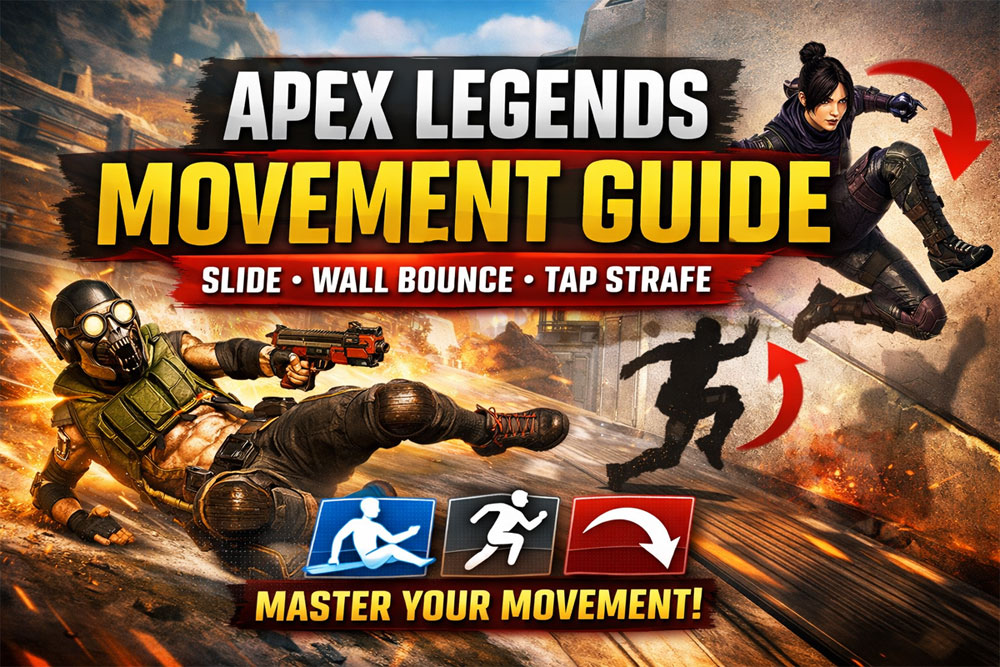
Apex Legends Movement Guide: Master Advanced Techniques to Outplay Everyone
Movement separates good Apex players from great ones.




You’ve probably been lasered by someone who seemed impossible to hit. They’re sliding around corners, bouncing off walls, and changing direction mid-air like they’re playing a different game. That’s not luck or even necessarily the Apex Legends cheats with aimbot from Battlelog—it’s mastering movement mechanics that the game doesn’t really explain.
Here’s the thing: every advanced movement technique in Apex is completely legal. Respawn knows about them. The pros use them. And once you learn them, you’ll wonder how you ever played without them.
This guide breaks down the essential movement tech that’ll make you harder to hit, faster around the map, and infinitely more dangerous in fights.
Why Movement Matters More Than Aim
Let’s get real about something most players overlook.
You can have perfect aim, but if you’re standing still or moving predictably, you’re dead. Meanwhile, someone with decent aim who can slide jump, wall bounce, and tap strafe will win that fight nine times out of ten.
Movement in Apex serves three purposes: getting places faster, dodging bullets, and creating angles your opponent doesn’t expect. The base sprint speed is 5.7 meters per second for most legends. But with proper technique, you can maintain momentum way beyond that.
The best part? None of this requires special hardware or settings. Just practice and muscle memory.
Slide Jumping: Your Foundation
Everything starts here.
Slide jumping is the bread and butter of Apex movement. Run forward, hold crouch to slide, then jump mid-slide while releasing crouch. Simple in theory, awkward at first, then second nature.
The real power comes from chaining them together. Each slide jump maintains and builds momentum, making you progressively harder to track. During a fight, a good player slide jumps constantly—never running in a straight line, always adding vertical and horizontal unpredictability.
Practice this in the firing range for five minutes. Just sprint, slide, jump, land, repeat. Get the rhythm down until your fingers do it automatically. That’s when you know you’ve got it.
Wall Jumping Changes Everything
Wall jumps (also called wall bounces) look flashy, but they’re genuinely useful.
Approach a wall at an angle while sliding. Jump into the wall, then immediately input backward or sideways movement—hit S or A/D keys. You’ll redirect your momentum in a new direction, often catching people completely off guard.
Here’s where it gets interesting: bind your scroll wheel to jump and forward movement. This makes the inputs way more forgiving. When you’re in a heated fight and need to bounce off a wall to escape or reposition, you don’t want to fumble the timing.
The practical application? Say you’re pushing through a door and there’s someone waiting. Slide in, wall bounce to the side, and suddenly you’re not where they expected. They’re tracking empty space while you’re getting shots on them.
Bunny Hopping for Evasion
Bunny hopping isn’t about speed in Apex—it’s about being annoying to hit.
Start with a slide jump. Release your movement keys while holding crouch, then jump the instant you land. For the basic forward bunny hop, that’s all you need. But the side-to-side variation is where things get spicy.
Alternate between A and D keys while doing slow mouse sweeps left and right every few hops. You’ll zigzag indefinitely, creating an erratic target that’s tough to track. When you’re healing behind cover and need to reposition, bunny hopping makes you way harder to hit than just running.
Does it look weird? Absolutely. Does it work? Ask anyone who’s tried to hit a bunny-hopping Octane.
Tap Strafing: The Air Control Cheat Code
Tap strafing feels like cheating the first time you pull it off.
While slide jumping, hold A or D. At the peak of your jump, flick your scroll wheel (with jump bound to it) and release W. You’ll turn 90 to 180 degrees in mid-air, completely changing direction without losing momentum.
This is insane for repositioning during fights. You can slide jump toward cover, then tap strafe behind it in one smooth motion. Or fake a push by jumping toward someone, then tap strafing away before they can line up their shot.
Console players can’t tap strafe due to controller limitations, which is why it’s particularly powerful on PC. Use that advantage.
Super Gliding: High Risk, High Reward
Super glides are the movement tech that makes spectators think you’re hacking.
While climbing a wall or ledge, crouch and jump almost simultaneously—crouch needs to be about one frame before jump. The timing is brutally precise. When you nail it, you launch forward with massive momentum.
Most players bind C and Space close together or use specific timing tools to practice. The firing range has perfect walls for drilling this. Expect to fail a lot before you get consistent.
Is it worth learning? If you play ranked seriously, yes. The ability to super glide onto a roof or over a wall during a fight creates opportunities that shouldn’t exist. But don’t stress if you can’t get it down—plenty of Predator players rarely use super glides.
Lurch Strafing: Advanced Air Movement
Lurch strafing builds on tap strafing and isn’t for beginners.
The two main variations are Ras (jump with A, tap W/D/S simultaneously) and Yuki (jump with W/A, tap S/A). Both add horizontal velocity or redirect you mid-air. Horizon players particularly love this because her passive makes air movement even more effective.
Here’s the honest take: most players will never need lurch strafing. It’s the kind of thing you see in pro scrims or high-level ranked. If you’re still working on consistent slide jumps and wall bounces, focus there first. Movement mastery is about layers, not learning everything at once.
Settings and Bindings That Actually Matter
Your settings can make or break your movement execution.
Bind scroll wheel up or down (or both) to forward movement and jump. This is non-negotiable for tap strafing and makes wall bounces way more forgiving. Some players also bind crouch to C instead of Ctrl for easier super glide timing.
In your gameplay settings, mess around with FOV. Higher FOV makes movement feel faster and gives you better peripheral vision. Most competitive players run 100-110 FOV.
Don’t sleep on your mouse sensitivity either. You need to be able to flick for tap strafes but still track targets accurately. Finding that balance takes experimentation, but generally lower is better for aim, while slightly higher helps with movement tech.
Putting It All Together
Learning movement techniques in isolation is one thing. Using them in actual fights is completely different.
Start in the firing range. Spend ten minutes each session just moving—slide jumps around the perimeter, wall bounces on the buildings, bunny hops between targets. Build muscle memory when there’s no pressure.
Then take it into real games, but don’t try everything at once. Focus on slide jumping for a few sessions. Then add wall bounces when you’re escaping or pushing. Layer in bunny hops when repositioning. The goal is making these movements automatic, not thinking about inputs during a fight.
Watch how good players move in high-level ranked games or ALGS tournaments. They’re constantly in motion—never standing still, always slide jumping between cover, using walls and terrain to create unpredictable angles. That’s the standard you’re working toward.
Final Thoughts
Movement in Apex is a skill ceiling that keeps rising.
You don’t need to master every technique to climb ranks, but the more tools you have, the more options you create in fights. A well-timed wall bounce or tap strafe can be the difference between winning and losing a crucial round.
The beautiful thing is that all of this is legal, ethical, and encouraged by the developers. These aren’t exploits—they’re emergent mechanics that reward practice and creativity. Unlike aiming, which has a natural limit based on reaction time and hand-eye coordination, movement skill can improve almost indefinitely.
So hit the firing range. Put in the reps. And the next time someone spectates you after you wipe their squad, they’ll be wondering how you moved like that.